

Beyond Medellín: Why Jericó Should Be Your Next Stop in Colombia’s Coffee Region
TRAVEL GUIDE · ANTIOQUIA, COLOMBIA · ECO TRAVEL
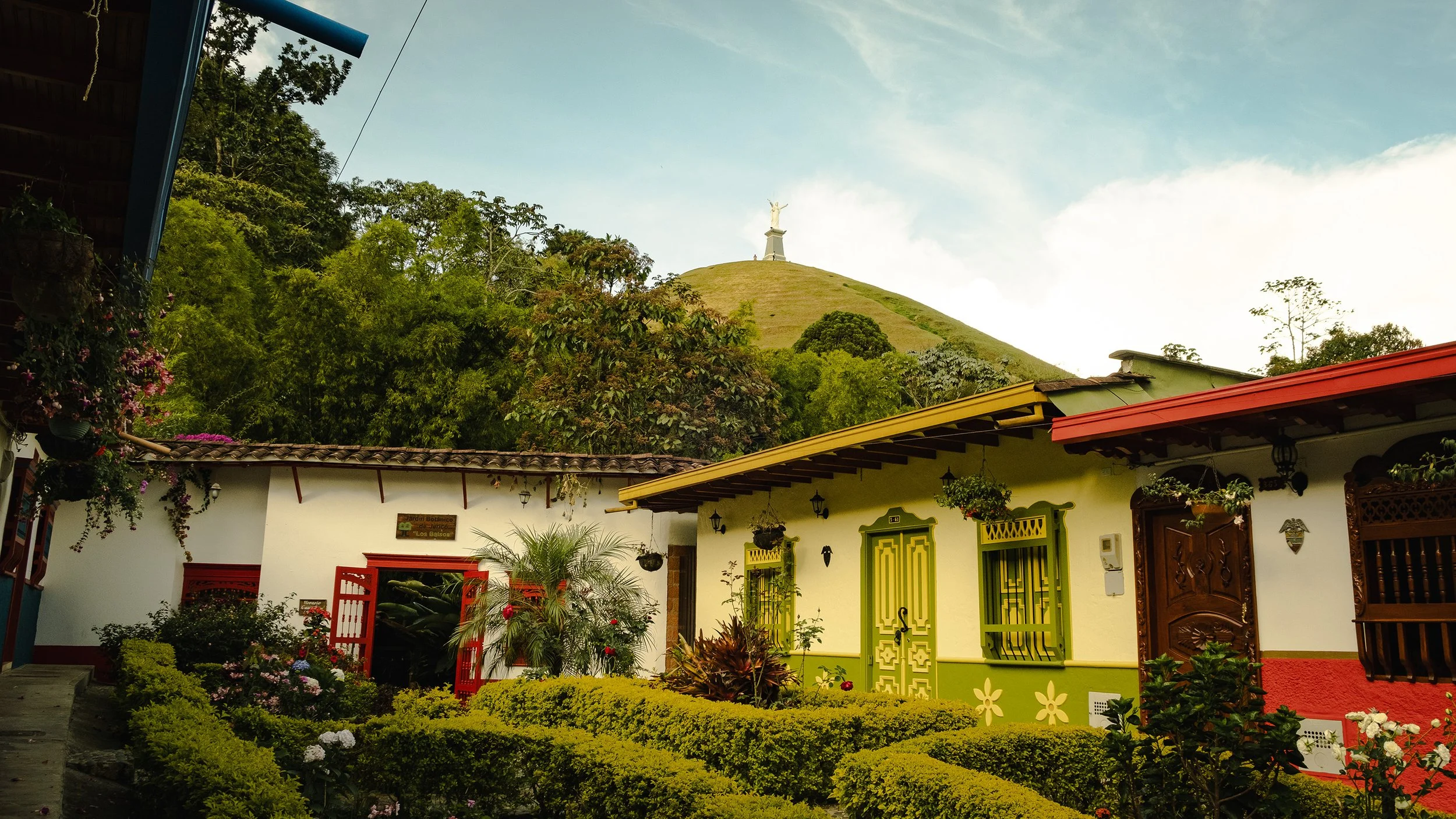
Entrance to the Botanic Garden
Most travelers to Colombia's coffee region follow the same trail: Medellín to Salento, maybe a stop in Jardín, then back. It's a beautiful route. But tucked into the mountains of southwestern Antioquia, largely off the gringo trail, is a town that subtly outshines them all — Jericó.
Designated a Pueblo Patrimonio by the Colombian government, Jericó combines centuries-old colonial architecture, a deeply rooted coffee culture, landscapes and biodiversity that would make any naturalist's jaw drop. If you're an eco-conscious traveler looking for the Colombia beyond the mainstream, this is your destination.
WHERE IS JERICÓ, AND HOW DO YOU GET THERE?
Jericó sits in the mountains of southwestern Antioquia, roughly 160 km from Medellín. It's about a 2-hour drive through some of the most surreal Andean scenery in the country. The road passes Cerro Tusa, a perfectly pyramidal mountain widely considered the largest natural pyramid in the world, before winding through impossibly windy switchbacks, cliffs that drop into river valleys, and roadside waterfalls that appear without warning. The journey is part of the experience. The town sits at around 1,910 meters above sea level; a misty pueblo where the clouds settle low over colonial rooftops and time seems to move at its own unhurried pace.
Getting there: We recommend a private transfer from Medellín — it allows stops along the way (Cerro Tusa is worth a pause) and is well worth the added cost for small groups. Uber is a reliable and affordable option for this route. For budget-conscious travelers, direct buses run hourly from Medellín's Terminal del Sur.
Best time to visit: Jericó has two dry seasons (December–February and June–August) when trails are most accessible. However, birders often prefer the shoulder months — September through November — when resident species are most active and cloud forest moisture keeps the landscape lush and alive.
WHAT MAKES JERICÓ DIFFERENT
Jericó isn't just picturesque; it's culturally and naturally remarkable in ways that take a moment to sink in.
A living heritage town
The Pueblo Patrimonio designation recognizes Jericó's exceptional preservation of traditional paisa culture: flower-filled balconies, handsome church plazas, and a pace of life that hasn't rushed to catch up with the 21st century. The town produced Colombia's only canonized saint, Blessed Laura Montoya, and the Cristo Rey statue overlooking the valley draws pilgrims and curious travelers alike.
Extraordinary biodiversity
Here's the number that stops most eco-travelers cold: the municipality of Jericó is home to more than 350 bird species. The surrounding cloud forests host endemic and near-endemic species, making this one of Colombia's most important birding corridors.
Travelers staying at Equilibrium Jericó — an ecohotel set within a private cloud forest reserve on the fringe of town — may encounter a significant number of those species on the property itself, with tanagers, hummingbirds, and motmots appearing with casual regularity on morning walks. That's more bird species than the entire country of Iceland — within a single municipality. Learn more about birdwatching at Equilibrium →
Coffee, done differently
Unlike the more commercialized coffee experiences in the Eje Cafetero, Jericó's coffee culture is woven into daily life rather than packaged for tourists. Family-run fincas have been cultivating arabica varietals on these hillsides for generations. Tasting here feels less like a tour and more like visiting a neighbor.
THINGS TO DO IN JERICÓ
Jericó offers more than most visitors expect. Below is a breakdown by interest — whether you're here for the culture, the coffee, or the cloud forest.
Culture, heritage, and town life
Start at the main plaza — the social and architectural heart of the town — where colorful facades, church bells, and the unhurried rhythm of paisa life converge. From there, Jericó's 17 churches are worth exploring; the Basílica Menor de la Inmaculada Concepción anchors the center, while the Templo Inmaculado Corazón de María holds touching tokens of gratitude left by devotees of Madre Laura — Colombia's first canonized saint, who was born here.
The Casa Museo de Santa Laura preserves her childhood home, filled with relics and managed by her religious community. For broader local history, the Centro de Historia, Museo de Arte Religioso, and the Museo Antropológico y de Arte (MAJA) are all small, affordable, and genuinely interesting — entry runs around 3,000 COP (~$1 USD).
One of Jericó's lesser-known traditions is the carriel — the iconic leather bag of the Antioquian campesino. Several open workshops around town let you watch craftsmen at work; a standout is the workshop of Eduard at Taller Martinez C. Artículos en Cuero, who puts a modern spin on the traditional form and offers hands-on workshops for those who want to try their hand at the craft.
The coffee experience
Coffee in Jericó is less a tourist attraction and more a way of life. For a guided bean-to-cup experience, El Sarturia offers professional tastings in a peaceful courtyard setting; one of the better introductions to the region's coffee culture. Café Campesino is the go-to for a more refined cup in a sleek modern atmosphere.
For a full farm-to-cup immersion, Ecoturismo La Nohelia, a working finca 10 minutes outside of town, offers guided coffee tours and even overnight stays in a charming bamboo-constructed cabin. Harvest months (October–December) are peak season: you can pick, process, and cup the same beans in a single afternoon.
Nature and adventure
Birdwatching: The cloud forest trails around Jericó and Pueblo Rico offer some of the most accessible high-quality birding in Colombia, with species ranging from the Crimson-rumped Toucanet to multiple species of euphonia and chlorophonia. Start at Equilibrium Jericó, a coffee in hand, watching tanagers and hummingbirds work the feeders from your terrace, then head out with a local expert for a deeper morning walk. See local feeder birds in action! →
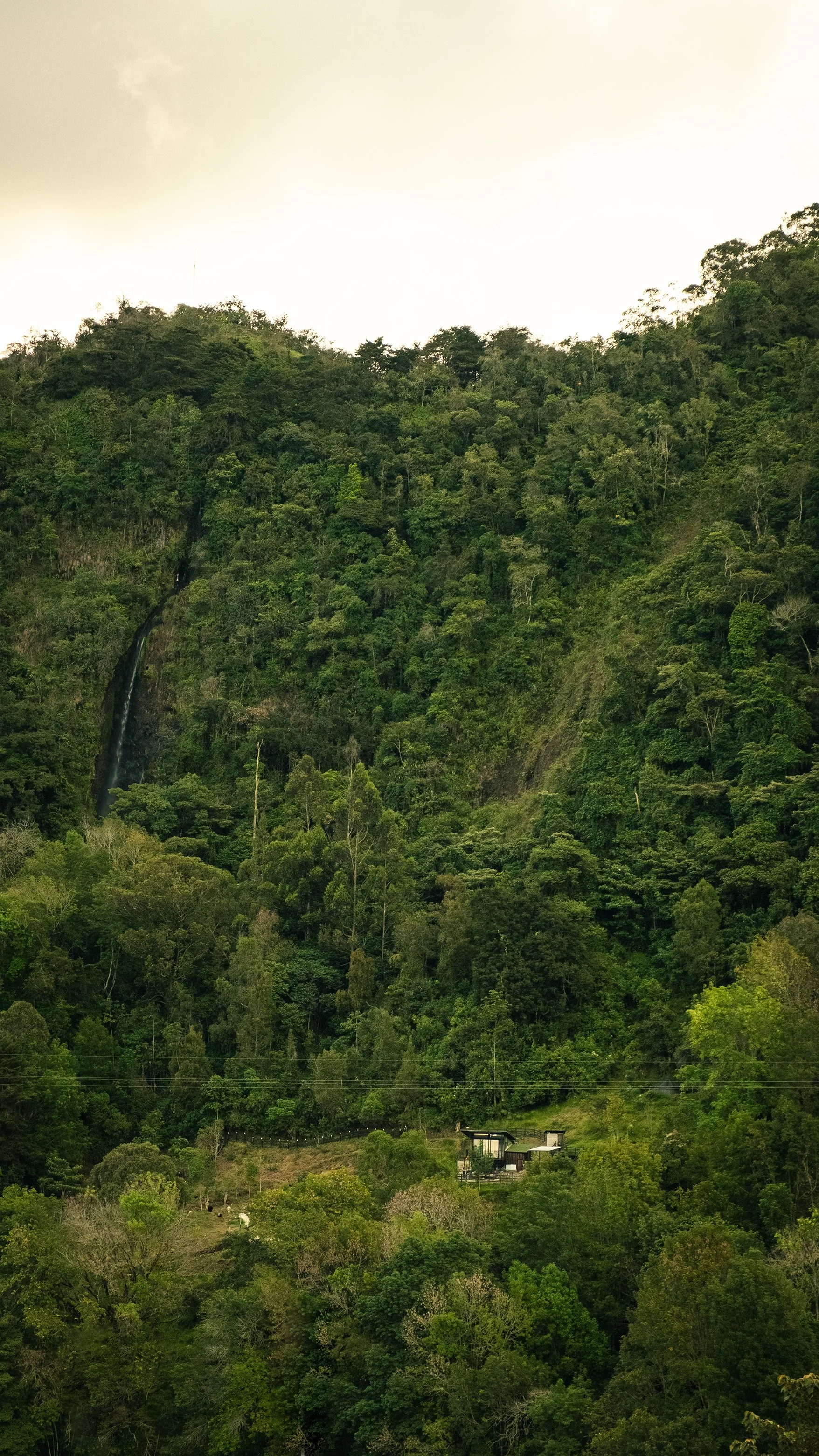
View of Equilibrium Jericó
Waterfalls: Guests at Equilibrium Jericó have access to a private waterfall within the reserve — a quiet, unhurried introduction to the landscape. The trail there is one of the best spots on the property for butterflies: keep an eye out for the Greta oto (the glasswing) — its wings almost entirely transparent save for borders of amber and black — alongside dozens of fluorescent species that drift through the cloud forest understory. Beyond the property, Salto de los Monos is a jaw-dropping adventure worth building a full day around, while Chorros del Quebradona is a technical scramble that rewards the effort with something few travelers ever see.
Viewpoints: The Jericó Botanical Garden and the Cristo Redentor hike are best experienced together. The garden sits at the base of the trail, a serene leafy oasis that makes a natural starting point before you climb to the summit. The views from Cristo Redentor over the town and valley are breathtaking, best at golden hour when the light catches the hillsides. Las Nubes is a separate mirador hike with an epic payoff of its own: the trail winds through cloud forest and opens onto views that, when the mist rolls in across the ridge, feel genuinely cinematic. It's one of those rare landscapes that exceeds the photos.
Paragliding: Ecoland offers tandem paragliding over the Jericó valley — a perspective on the landscape that's difficult to describe and hard to forget.
Horseback riding: Paseos a Caballo Jericó, run by Mauricio Suárez, offers rides for all skill levels. From a short afternoon climb to a hillside farm overlooking town, to longer countryside routes through the Antioquian landscape.
ATV tours: For those who want to cover more ground, quad bike tours navigate the rugged backroads around Jericó, reaching viewpoints and countryside that most travelers can't reach on foot.
Cycling tours: For serious two-wheeled exploration of the coffee corridor, Colombia Bicycle Adventures (colombiabicycleadventures.com) is the standout operator in the region. Founded by Tim and Lenore — two Colorado academics who arrived in Jericó sight unseen in 2022, fell in love with the landscape and the local cycling culture, and never quite left — the company runs small-group gravel and bikepacking adventures through some of the most beautiful and least-visited terrain in Antioquia.
Their flagship is the Tour del Café — a 9-day, 7-day-riding adventure through southwest Antioquia on gravel roads, double track, and smooth dirt across dramatic Andean terrain. Days are spent riding 4–6 hours through coffee fincas, charming small towns, and cloud forest, with side trips woven in: bird sanctuaries, waterfall swims, organic farms. Nights end at comfortable local hotels with proper meals and hot showers. Groups are intentionally small — 4 to 8 riders, 2 guides — which keeps the experience genuinely personal.
For those with less time, day rides and private trips of any length or difficulty can be arranged. The terrain is hilly but not technical; intermediate and advanced riders are the best fit. For a more assisted option, Equilibrium offers e-MTB tours in-house: a 2-hour route to neighboring Pueblo Rico, or a full-day ride through the corridor to Támesis. Book here.
Regenerative agriculture: Equilibrium guests are invited on a complimentary tour of the property's sustainable gardens, with a basket of freshly harvested fruits and vegetables to cook with back at the cabin. For a deeper immersion, partner agronomist Victor leads visits to Urantia — a pioneering regenerative agriculture project in the region — for those who want to understand the practice at its source.
WHERE TO STAY IN JERICÓ
Accommodation in Jericó ranges from simple guesthouses in town to more immersive nature retreats outside it. For eco-conscious travelers, the latter is worth prioritizing — proximity to the natural world dramatically changes the quality of the experience.
Equilibrium Jericó is the standout option for travelers who want a private natural space and proximity to town without sacrificing comfort. Set within a private cloud forest reserve, the ecohotel offers two thoughtfully designed cabins — the Refined Cabin and the Rustic Cabin — both featuring private hot tubs, full kitchens, and direct access to trails, a private waterfall, and the resident bird community. The on-site concierge can arrange guided birding, coffee experiences, and local day trips.
"It's the kind of place that becomes the reason you came, not just where you slept."
Booking tip: Direct bookings via equilibriumresorts.org are available and often come with added flexibility. The Rustic Cabin accommodates up to 4 guests — ideal for small groups or families traveling together.
For a characterful stay in town, Casa Linaje Hotel Boutique is the most celebrated option — a beautifully restored property with warm service and consistently glowing reviews. El Despertar is another strong choice, set in an Antioquian villa with a dramatic glass-roofed atrium, atmospheric and a short walk from the plaza.
Hotel Santa Laura is a reliable, well-located option two blocks from the main square, with mountain-view balconies, included breakfast, and consistently warm service.
WHERE TO EAT AND DRINK
Jericó's food scene is unpretentious and satisfying. Bandeja paisa, the iconic Antioquian platter of beans, rice, chicharrón, arepa, egg, and ground meat, is served with pride at local restaurantes corrientes. For something lighter, the market stalls near the main plaza do exceptional fresh juices and empanadas.
For a midday meal with a view, Bendito Café is the local favorite — their menú del día is consistently good, and the terrace overlooking the main plaza makes it one of the best people-watching spots in town. For the best steak, Montana Parrilla is the local standout. And if you're heading up to paraglide or just want a fresh salad and cleaner eating, Ecoland doubles as a restaurant with great views of the gliders coming in overhead.
Coffee, naturally, is everywhere. Look for locally roasted single-origin (café de origen) cups at the smaller cafés — the beans you'll drink in Jericó rarely travel far from the hillsides where they were grown.
PRACTICAL TRAVEL TIPS FOR JERICÓ
Currency: Bring Colombian pesos in cash. ATMs exist in town; always decline the conversion rate for the best exchange.
Connectivity: Cell coverage is good in town; more remote properties may have limited signal. Most accommodations offer WiFi.
Packing: Cloud forest weather means layers. Mornings are cool and misty (12–16°C), afternoons can warm up significantly. A light rain jacket is essential year-round.
Spanish: Jericó sees far fewer English-speaking tourists than Medellín or Cartagena. A few phrases go a long way; locals warmly embrace any effort.
Combining with other destinations: Jericó pairs naturally with Jardín (90 minutes away) and Támesis — a quieter, equally charming heritage town on the other side of the corridor that most travelers overlook entirely. For day trips with a specific focus, Pueblo Rico is a standout for birdwatching, while Cauca Viejo combines well with a paragliding session. Medellín is 2+ hours in one direction; Salento and the broader Eje Cafetero are accessible to the south.
THE BOTTOM LINE
Colombia's coffee region has no shortage of beautiful towns. What Jericó offers that most of them don't is local depth — a genuine sense of place, natural richness that rewards the curious, and an unhurried pace that is precious in today's world. It's the kind of destination that a growing number of travelers describe not as a stop on an itinerary, but as the reason they came back to Colombia.
If you've been looking for a way into the heart of Antioquia beyond the obvious, Jericó is it.
Planning a trip to Jericó? Equilibrium Jericó offers two private cabins within a cloud forest reserve with direct access to a private waterfall, 75+ recorded bird species, and a curated activity concierge. Visit equilibriumresorts.org to explore the cabins →
